


The Beagle is one of the most recognizable hound breeds in the world and has ranked among the top 10 most popular dogs in the United States for decades. Bred to hunt rabbits in packs, the Beagle packs an enormous personality into a compact, sturdy frame. Their combination of friendliness, portability, and an almost comically determined nose makes them a favorite of families, hunters, and airport security alike.
Breed Characteristics
History & Origin

Small hound dogs used for rabbit hunting existed in England as far back as the 1300s. The name "Beagle" likely derives from the Old French word "begueule," meaning open throat or loudmouth, a reference to the breed's distinctive howl. By the 1500s, most English gentlemen kept packs of hounds, with larger dogs for deer and smaller ones for rabbits. These smaller hounds were the Beagle's ancestors.
Queen Elizabeth I kept a pack of "Pocket Beagles" that stood only 8 to 9 inches tall, small enough to fit in a saddlebag. These tiny dogs were more novelty than serious hunters and eventually died out. The hunting Beagle that survived was the standard-sized version used by farmers and foot hunters who could not afford horses. This democratic appeal shaped the breed. A Beagle pack could be followed on foot by anyone, not just the wealthy.
The modern Beagle took shape in the 1830s when Reverend Phillip Honeywood established a pack in Essex, England, that became the foundation for the breed standard. His dogs were bred strictly for hunting ability: nose, stamina, and voice. Around the same time, Thomas Johnson refined the breed for both appearance and field performance, producing a smoother, more attractive dog that could still work.
Beagles arrived in the United States after the Civil War. General Richard Rowett of Carlinville, Illinois, imported high-quality English stock and refined the American Beagle. The AKC recognized the breed in 1885, making it one of the earliest registered breeds. The National Beagle Club of America was founded in 1888 and held its first field trial that year.
Today the Beagle ranks consistently in the top 10 most popular AKC breeds. The breed serves in the USDA's "Beagle Brigade," sniffing out prohibited agricultural products at U.S. airports and ports of entry. Their nose is their superpower: Beagles have approximately 220 million scent receptors, compared to about 5 million in humans.
The USDA's "Beagle Brigade" uses Beagles at airports to sniff out prohibited agricultural items in luggage. They were chosen over other scent breeds because their small size and friendly appearance are less intimidating to travelers than a German Shepherd or Bloodhound.
Appearance
The AKC recognizes two Beagle varieties based on height: those under 13 inches at the shoulder and those between 13 and 15 inches. Both varieties share the same breed standard otherwise. Weight ranges from 20 to 30 pounds depending on size. The Beagle should look like a miniature Foxhound: solid, sturdy, and built for endurance rather than speed.
The head is fairly long with a slightly domed skull and a moderate stop. The muzzle is straight, square-cut, and medium in length. The large, soft eyes are brown or hazel, set well apart, and carry the gentle, pleading expression that has melted countless owners' resolve against giving table scraps. The ears are long, set low, and round at the tip. When drawn forward, they should reach nearly to the end of the nose. The ears' length and shape help funnel scent particles toward the nose when the dog is tracking.
The coat is short, dense, and hard enough to be weather-resistant. Any hound color is acceptable, but the most common pattern is the tricolor: black saddle over a white base with tan markings on the head, ears, and legs. Other patterns include red and white, lemon and white, and blue tick. The tail is set moderately high, carried upright with a slight curve, and tipped with white. The white tail tip was bred deliberately so hunters could see their dogs in tall grass.
The body is compact and muscular with a moderately broad chest and strong, short back. The legs are straight with plenty of bone, and the feet are round and firm. The overall build suggests a dog that can run all day without tiring. The gait is smooth and ground-covering, with the head carried low to the ground when the dog picks up a scent.
Temperament & Personality
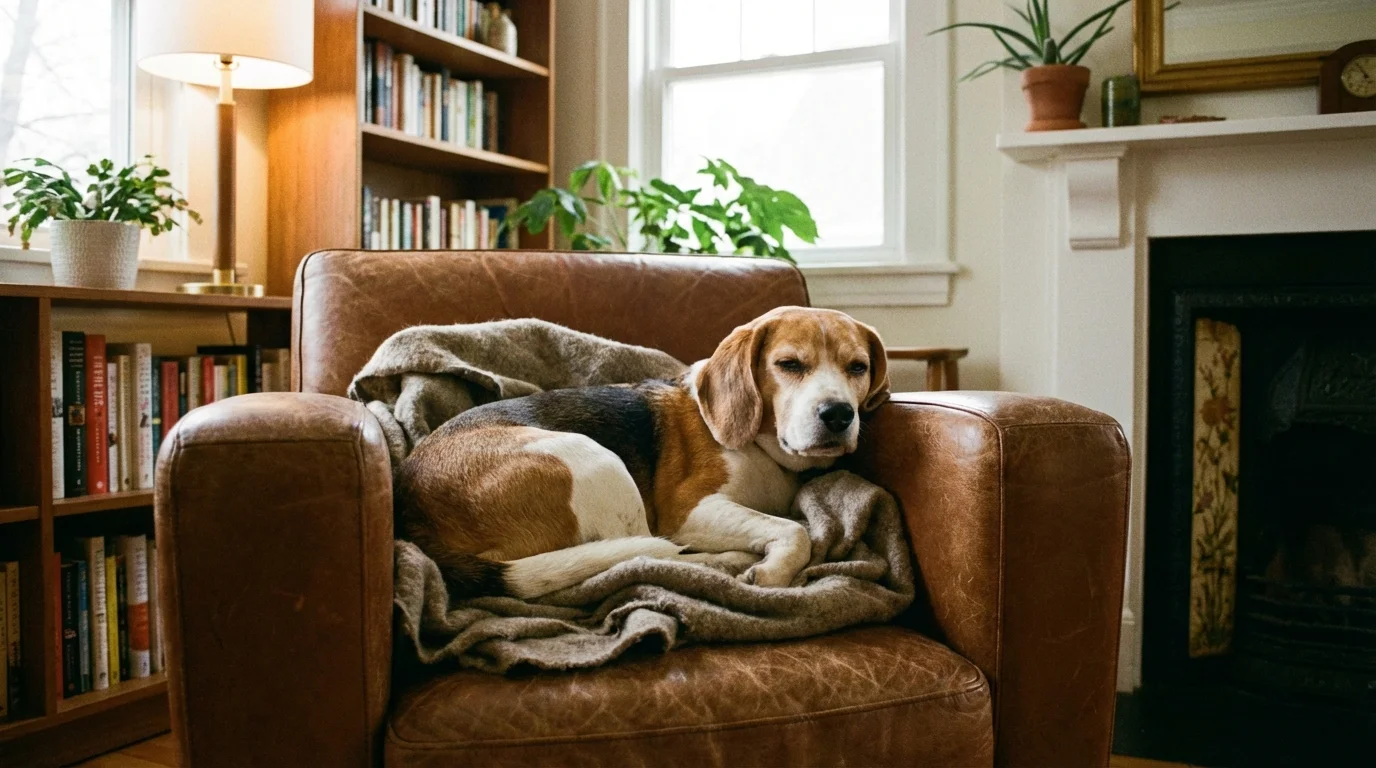
Beagles are happy dogs. The AKC standard uses the word "merry" to describe the breed's temperament, and anyone who has lived with a Beagle understands why. They approach life with a tail-wagging enthusiasm that is infectious. They are neither nervous nor aggressive, and their default setting is friendly curiosity toward everyone they meet.
As pack dogs, Beagles are deeply social. They get along well with other dogs, are generally good with cats (though their chase instinct can kick in), and thrive in households where someone is usually around. A Beagle left alone for long hours will express its displeasure through howling, which the neighbors will hear clearly, and through destructive behavior, which your furniture will show clearly.
The Beagle's nose runs the show. Once a Beagle locks onto a scent, everything else ceases to exist: your voice, your treats, the concept of roads and traffic. This is not disobedience. It is genetics. The breed has approximately 220 million scent receptors and a brain that dedicates 40 times more area to processing smell than the human brain does. When a Beagle follows a scent trail, it enters a state of single-minded focus that owners call "nose deaf."
Beagles are excellent with children. Their compact size means they are sturdy enough to handle rough play without being large enough to accidentally knock a toddler over. They are patient, tolerant, and seem to genuinely enjoy the noise and chaos of family life. Their pack mentality means they view children as part of their group and will happily include them in whatever activity is happening.
Food motivation is extreme in this breed. Beagles will eat anything, at any time, in any quantity. They are counter surfers, trash raiders, and masters of the pitiful stare. This food drive makes them easy to train with treats but also means you need to manage their diet carefully. Beagles are among the most obesity-prone breeds, and an overweight Beagle is at higher risk for back problems, joint issues, and heart disease.
Training & Exercise

Training a Beagle is an exercise in negotiation. They are intelligent dogs that learn quickly, but they are hound dogs first and obedience dogs second. The breed was developed to work independently, following a scent trail for hours without human direction. This independence means a Beagle will consider your command, weigh it against whatever its nose is telling it, and make its own decision.
Food-based training is by far the most effective approach. Beagles will do almost anything for a treat, and this food motivation is your primary training tool. Keep sessions short (5 to 10 minutes) and upbeat. Repetitive drills bore Beagles quickly, and a bored Beagle will wander off, both mentally and physically. Harsh corrections shut them down. They become anxious and stubborn rather than compliant.
Recall (coming when called) is the single hardest command to teach a Beagle. Many experienced Beagle owners never fully trust their dog off-leash in unfenced areas. A Beagle on a scent trail can cover remarkable distances in a short time and may not respond to its name, a whistle, or anything short of a physical interception. If you want off-leash reliability, start recall training from puppyhood, use extremely high-value rewards, and practice in progressively more distracting environments. Even then, be realistic about the limitations.
Adult Beagles need about 60 to 90 minutes of exercise per day. They are not as high-energy as a Husky or Border Collie, but they are far from couch potatoes. Brisk walks, hiking, and scent-based games are ideal. Nose work, barn hunt, and tracking trials tap into the breed's natural abilities and provide mental stimulation that physical exercise alone cannot match.
Beagles do well in a variety of dog sports. They excel at scent work and tracking competitions, perform well in rally and agility, and some compete in field trials. The breed's cheerful persistence and food motivation make them surprisingly competitive in structured training environments where the handler can keep the dog engaged.
Health & Care
Beagles are generally healthy dogs with a long lifespan of 10 to 15 years, well above average for their size. The breed benefits from a relatively broad gene pool and a history of selection for working ability rather than extreme physical traits.
The most common health concern in Beagles is intervertebral disc disease (IVDD), which affects the cushioning discs between the vertebrae in the spine. Symptoms range from mild pain to partial or full paralysis. Maintaining a healthy weight is the single best preventive measure, as excess weight puts additional strain on the spine. Epilepsy occurs at a higher rate in Beagles than in many other breeds. Seizures typically begin between 6 months and 3 years of age and are usually manageable with medication.
Hypothyroidism (underactive thyroid) is common, causing weight gain, lethargy, and skin problems. A simple blood test can diagnose it, and daily medication controls it effectively. Cherry eye, a prolapse of the gland in the third eyelid, occurs occasionally and may require surgical correction. Hip dysplasia is less common than in larger breeds but does occur.
Musculoskeletal Beagle Pain Syndrome (also called Beagle meningitis or steroid-responsive meningitis) is a condition specific to the breed. It typically affects puppies between 5 and 10 months old, causing fever, neck stiffness, and pain. It responds well to corticosteroid treatment when caught early.
Grooming is straightforward. The short, dense coat requires brushing once or twice a week to remove loose hair and distribute oils. Shedding increases in spring and fall but is manageable compared to double-coated breeds. Bathe every 4 to 6 weeks or as needed. The floppy ears trap moisture and need weekly cleaning to prevent infections. Check after swimming or baths. Trim nails every 2 to 3 weeks and brush teeth several times per week.
Weight management is critical. Beagles love food, will eat well past full, and gain weight easily. Feed measured portions on a schedule rather than free-feeding, and resist those pleading eyes. An overweight Beagle is at significantly higher risk for IVDD, joint problems, heart disease, and diabetes.
Living With a Beagle
Beagles adapt well to a variety of living situations, from apartments to homes with large yards, as long as they get adequate exercise and companionship. They are compact enough for apartment living, but their tendency to howl and bay can be a problem in buildings with shared walls. If you have neighbors in close proximity, this is worth considering before getting a Beagle.
The howl is famous and unavoidable. Beagles were bred to be loud so hunters could locate them in thick brush. The breed produces three distinct vocalizations: a standard bark, a yodeling howl (the "bay" used when tracking), and a full-throated howl. Many Beagles howl when left alone, when they hear sirens, when they see something exciting through the window, or simply because they feel like it. You can manage excessive howling through training and by addressing its causes (boredom, loneliness), but you cannot train it out of the breed entirely.
Secure fencing is necessary. Beagles will follow a scent through an open gate, under a loose fence board, or over a low barrier without a second thought. A 5-foot fence with a secure bottom is the minimum. Check for gaps and weak points regularly. Electronic fences are generally unreliable for Beagles because the desire to follow a scent often overrides the correction.
Beagles are social dogs that do best with company. If you work full time, consider getting two Beagles. They genuinely enjoy each other's company, and a pair of Beagles will keep each other entertained and create less destructive mischief than a single bored Beagle. They also do well with other dog breeds and can coexist with cats, especially if introduced as puppies.
Keep food secured. Beagles are creative foragers who will open cabinets, tip over trash cans, pull items off counters, and eat things that are not technically food. Child-proof locks on lower cabinets, a locking trash can, and the habit of never leaving food unattended will save you multiple vet visits.
Beagles make outstanding first-time dogs for active families who understand the breed's noise level and scent-driven personality. They are forgiving of training mistakes, good-natured with children, easy to groom, and small enough to manage physically. Their worst quality is also their most endearing: the relentless, joyful, sometimes inconvenient devotion to following their nose wherever it leads.
Cutest Beagles on Pupvote
Top Beagle Names on Pupvote


Frequently Asked Questions
Beagles are one of the best family breeds available. They are gentle with children of all ages, sturdy enough for active play, and naturally pack-oriented, meaning they see the family as their group. Their compact size (20 to 30 pounds) makes them manageable for most households. The main considerations are their exercise needs (60 to 90 minutes daily), their tendency to howl, and their powerful food drive, which means you need to keep food out of reach.
Adult Beagles need 60 to 90 minutes of daily exercise. Brisk walks, hiking, and scent-based games like nose work or tracking are ideal because they engage both the body and the brain. Without enough activity, Beagles become bored and channel their energy into howling, digging, and destructive chewing. Puppies need shorter, more frequent play sessions to protect growing joints.
Beagles shed moderately year-round, with heavier shedding in spring and fall. Their short, dense double coat releases less hair than long-coated breeds, but it still accumulates on furniture and clothing. Weekly brushing with a bristle brush or hound glove keeps shedding manageable. They are far easier to groom than breeds like Huskies or Golden Retrievers.
Beagles live 10 to 15 years, with many reaching 12 to 13 years. This is an above-average lifespan for their size. The most common health issues that affect longevity are intervertebral disc disease (IVDD), epilepsy, and obesity-related conditions. Keeping your Beagle at a healthy weight is the single most effective thing you can do to extend its life.
Beagles are intelligent but independent, which makes them moderately difficult to train. They learn commands quickly when food rewards are involved but may ignore those commands when their nose finds something more interesting. Recall off-leash is the biggest challenge. Positive reinforcement with high-value treats works best. Short, varied training sessions prevent boredom. Many experienced Beagle owners never fully trust their dog off-leash in unfenced areas.
Beagle puppies from reputable breeders cost $800 to $1,500, with show-quality dogs from field champion lines reaching $2,000 or more. Breeders should screen for hip dysplasia, eye conditions, and the MLS gene (Musladin-Lueke Syndrome). Adopting from a Beagle rescue typically costs $200 to $400. Annual expenses for food, veterinary care, and supplies run $1,000 to $1,500.