


The Siberian Husky was built to run. Bred by the Chukchi people of northeastern Siberia to haul sleds across frozen tundra, this breed combines breathtaking endurance with a personality that is equal parts affectionate and independent. Their piercing blue eyes and wolf-like looks get attention, but it is the Husky's playful, sometimes exasperating temperament that earns lasting devotion from their owners.
Breed Characteristics
History & Origin

The Siberian Husky is one of the oldest dog breeds, developed over thousands of years by the Chukchi people of northeastern Siberia. The Chukchi relied on their dogs for survival. These sled dogs hauled supplies across vast stretches of frozen tundra, slept alongside children for warmth, and were treated as valued members of the family. The breeding was purposeful: the Chukchi selected for endurance, a cooperative temperament, and the ability to work on minimal food in extreme cold.
The breed arrived in Alaska in 1908 when a Russian fur trader named William Goosak brought a team to compete in the All Alaska Sweepstakes, a 408-mile dogsled race from Nome to Candle and back. Locals laughed at the relatively small dogs, calling them "Siberian rats" compared to the larger mixed breeds used by Alaskan mushers. Goosak's team finished third. The following year, Fox Maule Ramsay imported more Siberian dogs, and his teams won the Sweepstakes in 1910. The racing community took notice.
The breed earned its place in history during the 1925 serum run to Nome, when a diphtheria epidemic threatened the isolated town. Twenty mushers and their sled dog teams relayed antitoxin serum across 674 miles in five and a half days through blizzard conditions. Gunnar Kaasen and his lead dog Balto ran the final leg into Nome, and Leonhard Seppala and his lead dog Togo covered the longest and most dangerous stretch. A statue of Balto stands in Central Park in New York City. Togo, who covered 264 miles compared to Balto's 53, is now widely considered the true hero of the run.
The AKC recognized the Siberian Husky in 1930. The breed served in the U.S. Army's Arctic Search and Rescue Unit during World War II. Today the Siberian Husky consistently ranks among the top 15 most popular breeds in the United States, valued both as a companion and as a competitive sled dog. The breed standard has changed remarkably little from the dogs the Chukchi developed centuries ago.
During the 1925 serum run to Nome, Leonhard Seppala's lead dog Togo covered 264 miles of the most treacherous terrain at age 12. Seppala later called Togo "the greatest sled dog that ever lived."
Appearance
The Siberian Husky is a medium-sized working dog built for speed and endurance rather than raw power. Males stand 21 to 23.5 inches at the shoulder and weigh 45 to 60 pounds. Females are slightly smaller at 20 to 22 inches and 35 to 50 pounds. The overall impression is one of balance, effortless movement, and compact power without excess bulk.
The head is proportional to the body with a slightly rounded skull and a well-defined stop. The muzzle is medium in length and width, tapering to the nose. The eyes are the breed's most distinctive feature: almond-shaped and moderately spaced, they can be blue, brown, amber, or any combination. Heterochromia (one blue eye and one brown) and parti-colored eyes (two colors within the same eye) are common and perfectly normal in the breed. The expression is keen, friendly, and sometimes mischievous. The ears are medium-sized, triangular, set high on the head, and carried erect.
The double coat is medium in length and gives the dog a well-furred appearance without obscuring the body's outline. The undercoat is soft and dense, providing insulation in temperatures far below zero. The outer coat is straight and lies smoothly. Coat colors include black and white, gray and white, agouti, red and white, sable and white, and pure white. Facial markings vary widely, from full masks to open faces, and no two Huskies have exactly the same pattern.
The body is moderately compact with a straight, strong back. The chest is deep but not broad, reaching to the elbows. The well-furred tail is fox-brush shaped, set just below the topline, and carried in a graceful sickle curve when the dog is alert. At rest, the tail hangs down. The gait is smooth, seemingly effortless, and quick. A Husky in motion covers ground with minimum expenditure of energy, which is exactly what the breed was designed to do.
Temperament & Personality

Siberian Huskies are pack animals to their core. They are social, outgoing, and genuinely enjoy being around people and other dogs. Unlike many working breeds, Huskies were bred to live in close contact with humans, sleeping in the family dwelling for warmth. This history produced a dog that craves companionship and does poorly when left alone for extended periods.
Their intelligence is undeniable, but it comes with a streak of independence that frustrates many first-time owners. Huskies understand what you want them to do. They just may not agree that it is worth doing. This is not defiance in the way a dominant dog challenges authority. It is more like the difference between a willing employee and an independent contractor. A Husky evaluates your request and decides whether to comply based on what is in it for them. This trait made sense in sled teams: a lead dog that blindly obeyed a musher's command to cross thin ice would kill the whole team.
Huskies are notably gentle. Aggression toward humans is extremely rare in the breed and is considered a serious fault. They greet strangers with enthusiasm, which makes them terrible guard dogs. A Husky will happily show a burglar around the house. They are patient with children, tolerant of handling, and generally friendly with other dogs, especially when properly socialized.
The breed is vocal in unusual ways. Huskies rarely bark, but they howl, yodel, chirp, and produce a range of vocalizations that owners describe as "talking." Some Huskies will carry on extended "conversations" with their owners, complete with dramatic intonation. This is entertaining at home and less entertaining at 6 AM on a Saturday.
Escape artistry is practically a breed characteristic. Huskies can dig under fences, jump over them, open latches, and find weaknesses in enclosures that would contain any other breed. This is not separation anxiety. It is curiosity and a strong prey drive combined with problem-solving intelligence. A Husky that escapes is not looking for you. It is exploring.
Training & Exercise
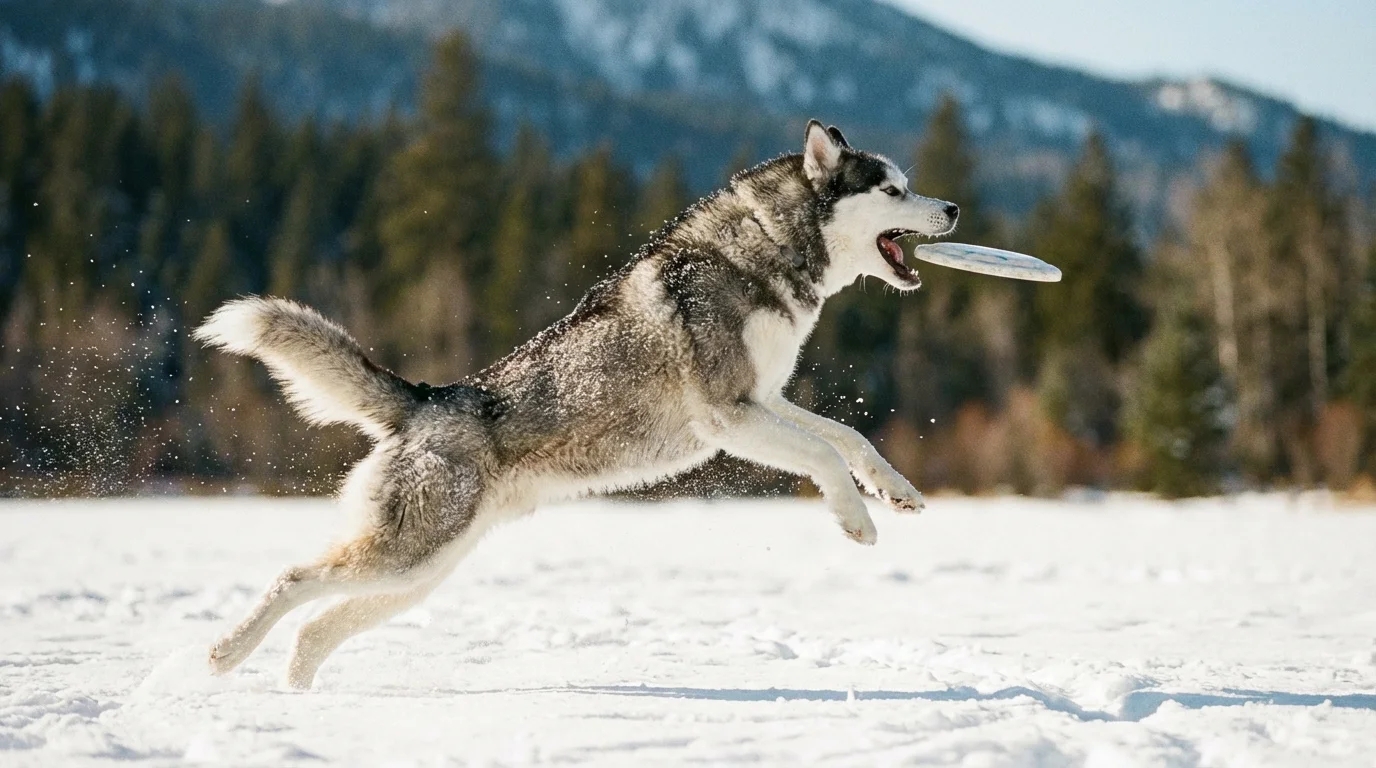
Training a Siberian Husky requires patience, creativity, and a sense of humor. The breed ranks 77th in Stanley Coren's intelligence trials, but this ranking reflects willingness to obey rather than cognitive ability. Huskies learn commands quickly. They simply decide on a case-by-case basis whether to follow them. Punishment-based training backfires with this breed. A Husky that is corrected harshly will become evasive, not compliant. Positive reinforcement with high-value treats produces the best results, and even then, recall off-leash is never truly reliable.
Start training early and keep sessions short, varied, and engaging. Puppies should learn basic obedience by 4 months. Socialization is important but usually easy with Huskies since they naturally enjoy meeting new people and dogs. The bigger challenge is impulse control. Huskies have a strong prey drive and will chase cats, squirrels, rabbits, and anything else that runs. Teaching a solid "leave it" from puppyhood is essential if you have small animals in the household.
Exercise is non-negotiable and the single most important factor in living successfully with a Husky. Adults need a minimum of 2 hours of vigorous activity per day. This means running, hiking, biking alongside you, or pulling a sled or cart, not a casual walk around the block. A 30-minute leash walk will take the edge off, but it will not satisfy a breed designed to run 100 miles a day in sub-zero temperatures.
Off-leash exercise is risky because most Huskies cannot be trusted to come when called, especially when a squirrel is involved. Secure, fenced areas (with fencing that extends underground to prevent digging) are the safest option. Dog parks can work if your Husky is well-socialized, but be prepared for the possibility that your dog will find the fence's weak point.
Careful with exercise in warm weather. Huskies overheat easily. Their double coat insulates against cold but also traps heat. Exercise in early morning or evening during summer, provide constant access to water, and watch for signs of overheating: excessive panting, drooling, and reluctance to move. Huskies can and do live in warm climates, but owners need to manage their activity schedule around the temperature.
Health & Care
Siberian Huskies are one of the healthier purebred breeds, with a lifespan of 12 to 14 years. Their genetics reflect thousands of years of natural selection in harsh conditions where only the fittest survived. That said, several hereditary conditions are worth knowing about.
Eye problems are the breed's primary health concern. Juvenile cataracts can appear as early as 3 months of age and may progress to impair vision. Progressive retinal atrophy (PRA) causes gradual vision loss and eventual blindness. Corneal dystrophy produces white or grayish opacities in the cornea. The Canine Eye Registration Foundation (CERF) exam is a standard screening, and reputable breeders have their dogs' eyes examined annually. The Siberian Husky Club of America requires CERF clearance for its breeder referral program.
Hip dysplasia occurs at lower rates than in many breeds of similar size. The OFA reports that roughly 5% of evaluated Siberian Huskies show some degree of hip dysplasia, compared to 20% for German Shepherds. Breeders should still X-ray breeding stock. Hypothyroidism is seen occasionally and is manageable with daily medication.
Grooming a Siberian Husky revolves around the coat. They shed moderately year-round and blow their entire undercoat twice a year, typically in spring and fall. During a coat blow, hair comes out in clumps and will cover your floors, furniture, clothing, and food within hours. Daily brushing with an undercoat rake during these periods is the only way to manage it. Outside of coat-blow season, brushing two to three times per week is sufficient.
Do not shave a Husky. The double coat insulates against both cold and heat, protects against sunburn, and does not grow back the same way if shaved. Bathe only when necessary, roughly every 3 to 4 months, as the coat is naturally clean and odor-free. Huskies are one of the least "doggy-smelling" breeds. Trim nails every 2 to 3 weeks, check ears weekly, and brush teeth several times per week.
Living With a Siberian Husky
Siberian Huskies are high-maintenance dogs in terms of exercise and containment, but remarkably easy in other respects. They are clean, have little odor, and groom themselves almost like cats. They are gentle, social, and rarely aggressive. The trade-off is that they demand a lifestyle commitment that many people underestimate.
Fencing must be serious. A 6-foot fence is the minimum, and it should extend at least a foot underground or have a concrete footer to prevent digging. Chain-link is easier for Huskies to climb than solid wood. Check gates and latches regularly because Huskies figure out how to open them. Many Husky owners add coyote rollers to the top of their fences, rolling bars that spin when the dog tries to grip the top.
Separation anxiety is less common in Huskies than in velcro breeds like Labs, but boredom destruction is a real problem. A Husky left alone without sufficient exercise will remodel your home. They chew through drywall, tear up carpet, disassemble furniture, and have been known to chew through doors. Crate training from puppyhood helps, and a second dog for company reduces the damage considerably. Huskies are happier in pairs.
The prey drive means caution with cats and small animals. Some Huskies coexist peacefully with cats they are raised with, but many cannot override the instinct to chase. Small dogs and pocket pets are at particular risk. Introductions should be gradual and supervised, and you should always have a management plan for when you are not watching.
Huskies are vocal. If you live in an apartment or have noise-sensitive neighbors, this breed may not be practical. The howling and "talking" are part of the Husky experience, and while you can manage it to some degree, you cannot eliminate it.
The breed does well in cold climates, obviously, but adapts to moderate and even warm climates with appropriate management. Air conditioning is a must in hot areas. Provide shade, water, and limit exercise to cool parts of the day. Never leave a Husky in a car in warm weather, even briefly.
First-time dog owners can succeed with a Siberian Husky, but it requires honest self-assessment. If you are active, patient, comfortable with a dog that has its own opinions, and willing to invest in proper fencing and daily exercise, a Husky will reward you with a loyal, entertaining, and beautiful companion. If you want a dog that stays in the yard and comes when called every time, look at a different breed.
Cutest Siberian Huskys on Pupvote
Top Siberian Husky Names on Pupvote
More Siberian Huskys on Pupvote


Frequently Asked Questions
Siberian Huskies are excellent family dogs. They are gentle with children, rarely aggressive, and genuinely enjoy being around people. They were bred by the Chukchi people to live alongside families, including sleeping with children for warmth. The main considerations for families are the high exercise requirement (2+ hours daily) and the need for secure fencing, since Huskies are skilled escape artists.
Adult Huskies need at least 2 hours of vigorous exercise daily. This means running, hiking, biking, or pulling activities, not just a leash walk. They were bred to run 100 miles a day in arctic conditions, and that endurance is still in the breed. Without enough activity, Huskies become destructive, vocal, and develop escape behaviors. In warm weather, exercise should be limited to early morning or evening hours.
Yes, Huskies shed heavily. They lose hair year-round and completely blow their undercoat twice a year, usually in spring and fall. During coat blows, hair comes out in large clumps and daily brushing with an undercoat rake is necessary. Outside those periods, brushing 2 to 3 times per week helps manage shedding. Never shave a Husky, as the double coat provides insulation against both cold and heat.
Siberian Huskies live 12 to 14 years on average, which is longer than many breeds of similar size. They are one of the healthier purebred breeds, benefiting from thousands of years of natural selection in harsh conditions. The most common health concerns are eye conditions (juvenile cataracts, progressive retinal atrophy) rather than the joint problems that affect many larger breeds.
Huskies are intelligent but independent, which makes training a challenge. They learn commands quickly but decide on their own whether to obey. They rank low in obedience trials not because they lack intelligence, but because they lack the desire to please that makes breeds like Golden Retrievers so trainable. Positive reinforcement with high-value treats works best. Reliable off-leash recall is difficult to achieve with most Huskies.
Siberian Husky puppies from reputable breeders cost $1,000 to $2,500. Dogs from champion sled racing or show bloodlines may cost $3,000 or more. Reputable breeders screen for eye conditions (CERF exam) and hip dysplasia (OFA). Adopting from a Husky rescue typically costs $250 to $500. Budget $1,500 to $2,000 annually for food, vet care, grooming, and replacing items your Husky chews.