



Few breeds earn the kind of universal affection that Golden Retrievers enjoy. Bred to retrieve waterfowl in the Scottish Highlands, they turned out to be even better at retrieving human hearts. Their patient, eager-to-please nature has made them the third most popular breed in the United States for decades running.
Breed Characteristics
History & Origin

The Golden Retriever traces its origins to the Scottish Highlands in the mid-1800s, where a gentleman named Dudley Marjoribanks (later Lord Tweedmouth) set out to create the ideal gundog. His estate at Guisachan, near Inverness, became the birthplace of the breed. Marjoribanks kept meticulous breeding records from 1835 to 1890, and those studbooks survived, giving us an unusually clear picture of how the breed developed.
The foundation cross happened in 1868. Marjoribanks bred a yellow Wavy-Coated Retriever named Nous to a Tweed Water Spaniel named Belle. The Tweed Water Spaniel, now extinct, was a liver-colored dog known for its calm temperament and strong swimming ability. This first litter produced four yellow puppies that became the cornerstone of the entire breed. Over the next two decades, Marjoribanks introduced Irish Setter blood for a richer coat color, more Tweed Water Spaniel lines for water work, and a Bloodhound cross to improve scenting ability. Each cross was calculated to refine the dog he envisioned: a strong, biddable retriever that could handle the rough Scottish terrain and cold water while remaining gentle enough for the home.
The breed was first shown at a British dog show in 1908, registered with the Kennel Club in 1911 as "Retriever (Golden or Yellow)," and recognized by the AKC in 1925. Golden Retrievers reached the United States in the early 1900s through sport hunters who valued the breed's soft mouth, willingness to work, and steady disposition. By the 1970s, the breed had cemented itself in the American consciousness as the quintessential family dog. President Gerald Ford's Golden, Liberty, brought the breed into the White House and into living rooms across the country via nightly news broadcasts.
Lord Tweedmouth's original breeding records, spanning 1835 to 1890, survived and are now housed at the Kennel Club in London. They confirm that the breed began with a single cross between a yellow Wavy-Coated Retriever and a Tweed Water Spaniel in 1868.
Appearance
Golden Retrievers are well-proportioned, athletic dogs built for a full day in the field. Males stand 23 to 24 inches at the shoulder and weigh 65 to 75 pounds. Females are slightly smaller at 21.5 to 22.5 inches and 55 to 65 pounds. The overall impression is one of symmetry and balance, with no single feature exaggerated.
The head is broad with a clean, well-defined stop. The muzzle is straight and roughly the same length as the skull. The eyes are medium-large, dark brown, and set well apart, giving the face that warm, intelligent expression the breed is known for. The ears are rather short, set just above the eye line, and hang close to the cheek. When pulled forward, the tip of the ear should just cover the eye.
The coat is the breed's most recognizable feature. It consists of a dense, water-repellent outer coat that can be straight or wavy, and a thick undercoat that provides insulation in cold water and harsh weather. Coat color ranges from light cream to a deep, rich gold. The AKC standard penalizes extremely pale or extremely dark shades, though the Kennel Club in the UK accepts a wider color range including cream. Feathering is prominent on the chest, the backs of the legs, the underbody, and the tail.
The body is well-balanced with a deep chest that extends to the elbows, a level topline, and strong hindquarters that provide the drive needed for field work. The tail is thick and muscular at the base, carried level with the back or with a slight upward curve, and is heavily feathered. A Golden's tail is constantly in motion, which anyone who has had one near a coffee table can confirm.
Temperament & Personality
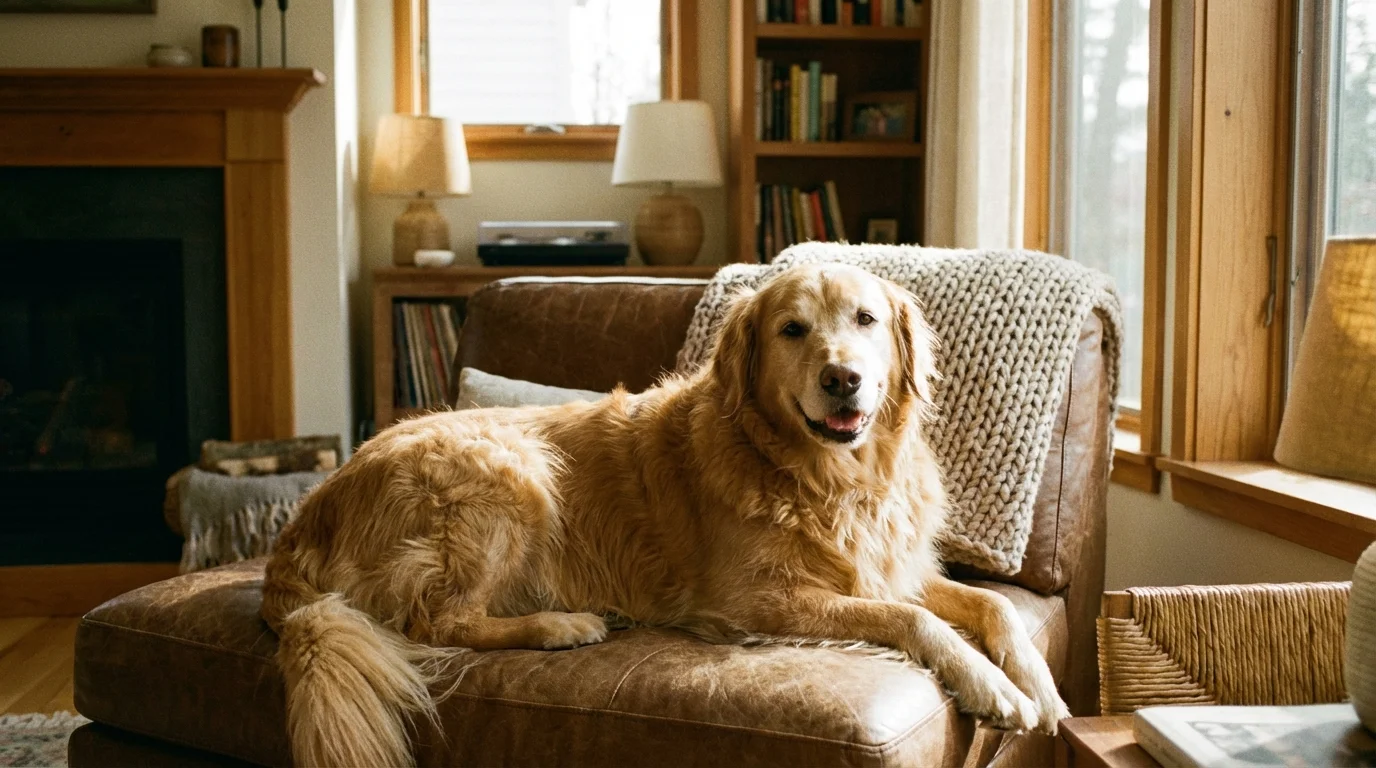
Golden Retrievers are, at their core, dogs that want to be near people and doing something useful. This combination of sociability and work ethic is what makes the breed so versatile. They serve as guide dogs, search-and-rescue dogs, therapy dogs, and competitive obedience dogs, all while being one of the best family companions available.
Their friendliness is genuine and nearly universal. Goldens are typically good with strangers, other dogs, cats (especially when raised together), and children of all ages. They tend to greet new people with a wagging tail and something in their mouth, because a Golden without something to carry is a Golden looking for something to pick up. This oral fixation is a holdover from their retrieving instinct. Provide plenty of chew toys, or you will find your shoes being gently presented to you.
Despite their easygoing reputation, Goldens are more sensitive than many people expect. They pick up on household tension, respond poorly to harsh corrections, and can become anxious if their routine is disrupted. They are not pushovers, but they are soft dogs emotionally. A raised voice affects a Golden far more than it would a more independent breed like a Husky or an Akita.
One thing Goldens are not is guard dogs. They will bark to alert you that someone is at the door, but the follow-up is almost always a full-body wiggle and an invitation to come inside. If you need a dog that will deter intruders, look elsewhere. If you need a dog that will comfort you after a bad day, curl up with your kids while they read, and still have the stamina to hike 10 miles on a Saturday, the Golden is hard to beat.
Maturity comes slowly to this breed. Many Goldens retain puppy-like energy and goofiness well into their third or fourth year. This extended adolescence is endearing but also means you are managing a 70-pound puppy brain for longer than with some other breeds. Patience during this phase pays off enormously.
Training & Exercise

Golden Retrievers are among the easiest breeds to train, ranking fourth in Stanley Coren's intelligence trials behind Border Collies, Poodles, and German Shepherds. They combine high intelligence with an intense desire to please, which means they pick up new commands in fewer than five repetitions and obey a first command 95% of the time. This trainability is a big part of why they dominate in obedience, agility, and service dog programs.
Positive reinforcement works best. Goldens are food-motivated, praise-responsive, and eager to repeat behaviors that earn rewards. Harsh training methods are counterproductive with this breed. They shut down under pressure rather than pushing back, and repeated harsh corrections can produce a timid, anxious dog. Keep sessions upbeat and varied. A bored Golden will start improvising, and their improvisations usually involve finding something to chew.
Socialization should start early and continue throughout the first year. Expose puppies to different people, environments, surfaces, and sounds between 8 and 16 weeks. Goldens are naturally sociable, but early socialization helps channel that sociability into polite behavior rather than jumping on every person they meet. Puppy kindergarten classes are an excellent investment.
Exercise is non-negotiable with this breed. Adult Goldens need 60 to 90 minutes of activity per day, and this should include both physical exercise and mental stimulation. A brisk walk alone will not cut it. They thrive on fetch games, swimming, hiking, and retrieval-based activities that engage their instincts. Many Goldens excel at dock diving, flyball, and field trials. A Golden that does not get enough exercise will redirect that energy into destructive behavior: digging, chewing furniture, counter surfing, and raiding trash cans.
Swimming deserves special mention because Goldens are natural water dogs. Most will take to water instinctively, and swimming is one of the best forms of exercise for the breed because it is easy on the joints while still providing a thorough workout. If you have access to safe water, this is the single best activity you can offer a Golden Retriever.
Golden Retrievers hold the Guinness World Record for the loudest bark by a dog, recorded at 113.1 decibels. They also hold records in obedience competitions, with the first three AKC Obedience Trial Champions all being Goldens.
Health & Care
Golden Retrievers live 10 to 12 years on average. They are generally healthy dogs, but the breed has some well-documented health concerns that every prospective owner should understand.
Cancer is the leading cause of death in Golden Retrievers, affecting an estimated 60% of the breed. Hemangiosarcoma (a cancer of the blood vessel lining) and lymphoma are the two most common types. The Morris Animal Foundation launched the Golden Retriever Lifetime Study in 2012, enrolling 3,000 Goldens to track cancer incidence and identify risk factors. Results from this ongoing study are shaping veterinary cancer research. While there is no way to prevent cancer entirely, buying from breeders who track cancer incidence in their lines and maintaining a healthy weight may reduce risk.
Hip and elbow dysplasia affect the breed at higher rates than average. The Orthopedic Foundation for Animals (OFA) reports that roughly 20% of Goldens evaluated show some degree of hip dysplasia. Reputable breeders have their breeding stock evaluated with OFA hip and elbow radiographs, and buyers should ask to see these clearances. Other recommended health screenings include an annual cardiac exam by a veterinary cardiologist, an annual eye exam by a board-certified veterinary ophthalmologist, and an NCL (neuronal ceroid lipofuscinosis) DNA test.
Grooming a Golden Retriever is a regular commitment. Their double coat sheds moderately year-round and heavily twice a year during seasonal "coat blows" in spring and fall. During these periods, daily brushing with an undercoat rake is the only way to manage the volume of loose fur. Outside of shedding season, brushing two to three times per week keeps the coat healthy and reduces the amount of hair on your furniture. Baths every 6 to 8 weeks are sufficient unless the dog gets into something messy, which Goldens will.
Ear infections are common because the breed's floppy ears trap moisture, especially after swimming. Check and dry the ears after every water session. Dental care matters too: brush teeth several times per week or provide dental chews to prevent periodontal disease. Nails should be trimmed every two to three weeks.
Living With a Golden Retriever
Golden Retrievers fit best in homes where someone is around for most of the day. They are social dogs that do not handle long stretches of isolation well. Leaving a Golden alone for 8 to 10 hours regularly is a recipe for anxiety, barking, and destructive chewing. If your household has a full-time schedule away from home, consider a dog walker, doggy daycare, or getting two dogs so they can keep each other company.
Space matters to some degree, but a big yard is less important than daily exercise. A Golden in a small house with an owner who runs with them every morning will be happier than a Golden with a five-acre yard and no interaction. That said, they are large, active dogs with enthusiastic tails, so very small apartments can feel tight. A home with room to move around and easy access to outdoor space is ideal.
Goldens and children are one of the best pairings in the dog world. Their patience, gentleness, and tolerance for noise and unpredictable movement make them outstanding family dogs. They will sit through tea parties, tolerate costume changes, and happily chase a ball with a six-year-old for an hour. That said, supervision is still important with toddlers. A 70-pound dog wagging its tail at full speed can accidentally knock over a small child.
Expect hair everywhere. On your couch, your clothes, your car seats, and somehow in your food. No amount of brushing will completely eliminate shedding, so a good vacuum cleaner and lint rollers in every room are part of the Golden Retriever starter kit. Light-colored furniture and clothing help camouflage the fur.
Goldens are mouthy dogs by nature. Puppies especially will put everything in their mouths, and adults retain a strong oral fixation. This is normal retriever behavior, not aggression. Redirect with appropriate chew toys and keep valuables out of reach during the first two years. Most Goldens mellow considerably by age three or four, though they never fully outgrow the habit of greeting you with a shoe or a sock in their mouth.
Cutest Golden Retrievers on Pupvote
 #1
#1McKey and I both love outdoors. His enthusiasm for adventure is palpable, especially when he hears the magic word "travel." It's his favorite catchword, and he's always ready to embark on a journey, anywhere, anytime. He has his favorite spot on the car too showing he's ready for an adventure.
85.3K+ votes #2
#2 #3
#3This sassy and sweet girl loves the outdoors, snuggles, and treats. She's intelligent, talkative, confident, and goofy. If there's something new to see or try, Frankie is up for the experience! Reliable streak buddy. Rest in peace to my dear, sweet, and adorable friend, Chase 🌈🐾 07/08/2024 https://www.pupvote.com/ca/detail/chase_1008759 Sending love to our friends, Jasper and his family, as they heal from the loss of their beloved Shamus 🤍🐾 Jasper: https://www.pupvote.com/ca/detail/jasper_1076423
2.5K+ votes #4
#4I’m Golden and I’m 4 months old. I love to play with my family and definitely run around my yard. I’m loving and like to cuddle
2K+ votesTop Golden Retriever Names on Pupvote
More Golden Retrievers on Pupvote
Frequently Asked Questions
Yes, significantly. Expect loose fur on your clothes, furniture, and car seats year-round. Twice a year, in spring and fall, the undercoat sheds in clumps and daily brushing becomes unavoidable. Outside those periods, two to three sessions per week keeps the worst at bay. Most Golden owners consider a good vacuum and a stockpile of lint rollers basic household supplies.
Few breeds match the Golden Retriever as an all-around family dog. They are patient enough to sit through a toddler pulling their ears, gentle enough to play with small children without getting rough, and social enough to welcome guests without drama. They also learn household rules quickly, which makes the adjustment period shorter than with many breeds. The one caveat: Goldens are people-oriented dogs that do not do well left alone all day. Families where someone is home regularly are the best fit.
Most Golden Retrievers live 10 to 12 years. The biggest threat to longevity is cancer, which accounts for roughly 60% of deaths in the breed. You can improve your dog's odds by buying from a breeder who screens for health issues across multiple generations, keeping your dog at a lean body weight (overweight dogs have shorter lifespans across all breeds), and staying current on vet visits. The Morris Animal Foundation's ongoing Lifetime Study of 3,000 Goldens is working to identify specific risk factors.
Plan on 60 to 90 minutes daily for an adult. Walks alone are usually not enough. Goldens were bred to work, so activities that tap into their instincts, like fetch, swimming, or scent games, satisfy them much more than a leash walk around the block. Puppies under 18 months need shorter sessions spread throughout the day, since too much impact on growing joints can lead to problems later. An under-exercised Golden will find its own entertainment, and that usually means your furniture suffers.
Cancer is by far the biggest concern. Hemangiosarcoma and lymphoma are the most common forms, and together they account for a disproportionate share of Golden deaths compared to other breeds. Joint problems are the next major issue: OFA data shows about 1 in 5 evaluated Goldens has some degree of hip dysplasia. Beyond those two categories, watch for chronic ear infections (moisture gets trapped under those floppy ears), skin allergies, and subvalvular aortic stenosis, a heart condition. Ask any breeder you consider for OFA hip/elbow clearances, a cardiac exam, an eye exam, and an NCL DNA test result.
A Golden Retriever from a reputable breeder typically costs $1,500 to $3,500, depending on lineage, health clearances, and location. Show-quality puppies from champion bloodlines can exceed $5,000. Avoid breeders selling well below market price, as this often signals cut corners on health testing. Adopting a Golden through a breed-specific rescue organization is another option and usually costs $300 to $600, covering spay/neuter, vaccinations, and a health screening.